

Notan Principle at Work
When I'm working on a painting or print design, I like to keep the traditional concept of Notan in mind. It's a Japanese word that's all about the dance between dark and light. Think of it as finding the perfect balance and contrast between black and white, or even between what's there and what's not (positive and negative space). It's like creating harmony on your canvas or block!

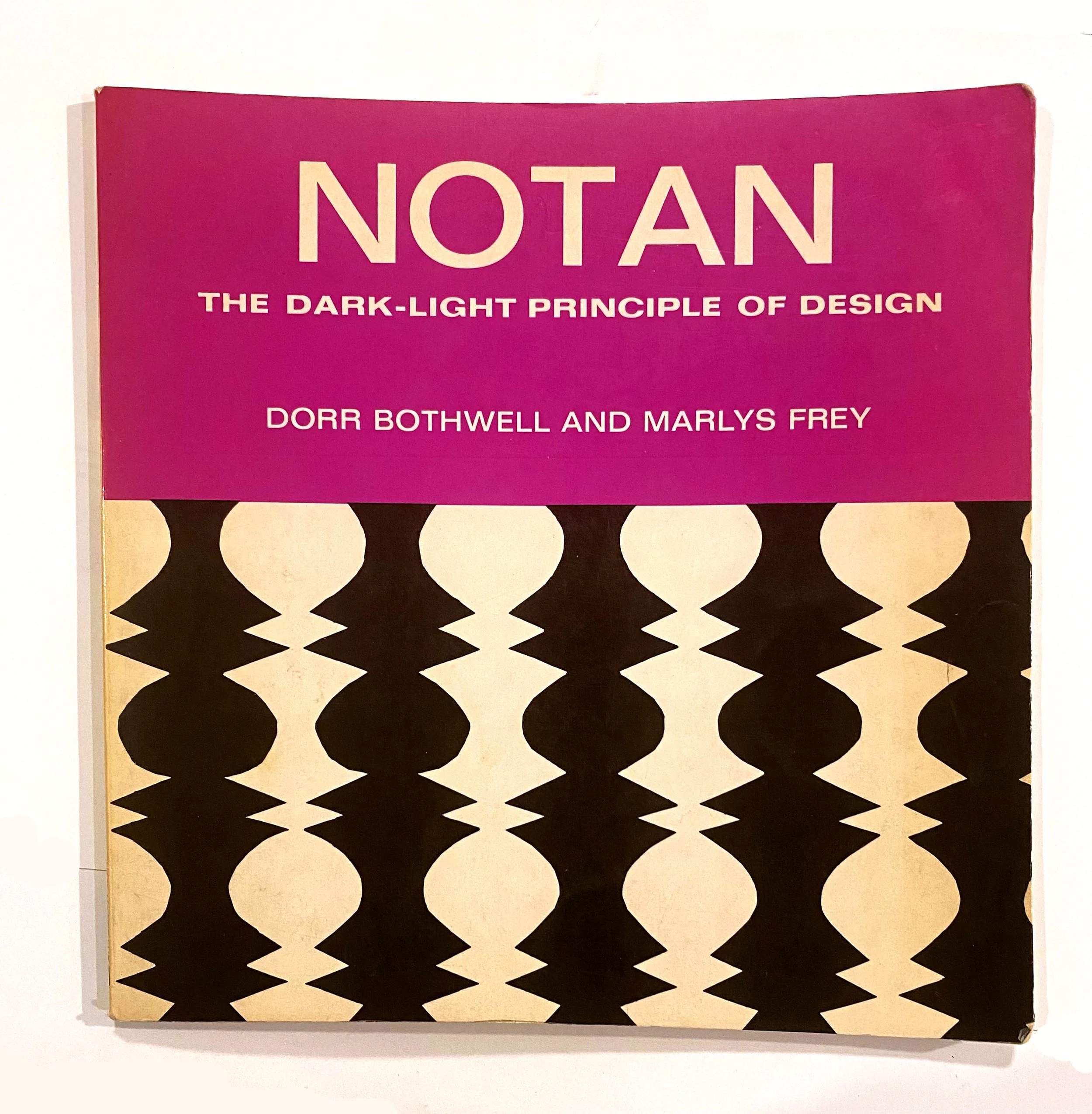
My journey with Notan began unexpectedly when I stumbled upon a hidden gem in a used bookstore in Seattle back in the '90s. This little-known concept piqued my curiosity, prompting me to purchase the book on a whim. Since then, it has become one of my most cherished resources—an ever-reliable guide that continues to inspire my work. Originally published in 1963, this timeless treasure remains in print to this day. You can discover it for yourself here.
Here are two simple exercises to help you grasp the concept of Notan in composition. You'll need black and white paper (preferably card stock), scissors or an Exacto knife, and a glue stick.
Exercise #1: 50/50 Composition
1. Cut the black paper to exactly half the size of the white paper (e.g., if the white paper is 8.5” x 11”, cut the black paper to 8.5” x 5.5”).
2. Cut various shapes from the black paper.
3. Glue all the shapes, plus the remaining black paper piece, onto the white paper in any arrangement. Ensure you use all of the black paper.
Your design should have a perfect balance of black and white.

Exercise #2: Expanded Square
1. Cut the black paper into a square approximately half the size of the white paper, or slightly less.
2. Place the square onto the middle of the white paper but do not glue it yet.
3. Cut shapes out from all four sides of the black paper and flip them outward to extend beyond the original square shape.
4. Continue cutting and flipping shapes around the square until you're satisfied with the arrangement.
5. Glue all the pieces down onto the white paper.

These exercises serve as an excellent starting point for designing a linocut image. Now, take a look around your environment. Where can you spot examples of the Notan principle in action?